Thursday, July 14, 2011

Polgár Back in 2700 Club

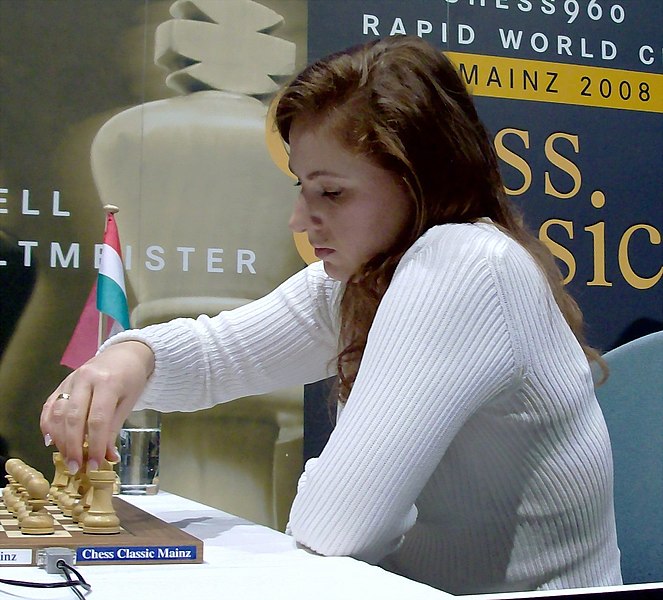
Due to her strong performance in the recent Greek Team Championships (her team won the event), Judit Polgár has finally broken the 2700 barrier again--a milestone for the tactical genius, as her rating took a nosedive back in 2008, and it's taken her almost three years to climb her way back up again.

File:Judit Polgar.jpg


Judit's recent stellar performances in Mexico (where she defeated both Ivanchuk and Topalov to take clear first) and the Euro Championships (where she tied for first, claiming the bronze medal on tiebreaks) have given her a big surge lately.

It remains to be seen whether the Hungarian heroine can make further gains at the World Team Championships, which start this Saturday. As Chess Indeed's Man-on-the-Street, Sir Robin of Sheboygan, pointed out: "Being on Board 3 should allow her to win many games!"

Go Judit!

Wednesday, June 29, 2011

Summer Lecture Series Announced

Chess Indeed's man-on-the-street Sir Robin of the Redwoods informs us that the Summer Lecture Series has finally been announced at the Snails Corners Chess Club in exotic Sheboygan, Wisconsin--and it looks like a doozy of a lineup!

Alvin Becker, renowned meteorologist and a strong "weak expert," will be discussing the following topics for anyone with enough stamina to sit still for four hours at a stretch:

International Master Captain Caveman will be
giving a simul during the lectures, making it even
harder for Becker to hold his audience's attention.

1. World championship games Alekhine obviously played while drunk

2. Bobby Fischer's 60 Memorable Anti-Semitic Rants

3. How to Avoid Fool's Mate--even if you're a fool

4. The ten shortest chessplayers of all time (surprisingly, the midget inside "the Turk" is only #3)

5. How to hypnotize your opponents using a large, hand-cranked spiral-generating device

6. A move-by-move analysis of Steinitz-God, Baden-Baden 1898

7. Chess is different from Checkers--here's how

8. Is Ivanchuk insane? A peek into the mind of a bewildered man

9. Fire on board: how to unobtrusively ignite a chessboard when you're losing

10. A look at the Ostrich Counter-Defense (1...Nh6 2...Ng8!?)

As usual, I will have a front-row seat for these lectures (by which I mean I'll be safe in my plush Boston hovel, one ear cocked vaguely toward Sheboygan as the other thrills to the dulcet crooning of Lionel Richie).

Wednesday, June 15, 2011

Unusual Tactics: Smothers Brothers Mate

Today Chess Indeed launches an exciting new series, Unusual Tactics, in which we spotlight rare tactical motifs and try and come up with ridiculous names for them.

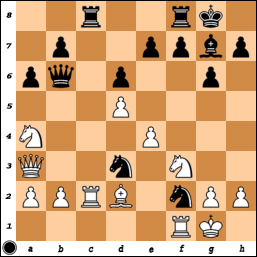
Today we look at what seems (at first glance) to be an ordinary run-of-the-mill Smothered Mate.


Every woodpusher knows the correct mating technique here: knight discovers double-check on h3, queen sham-sacs on g1, knight "seals the coffin" on f2, and everyone's home in time to watch Matlock.

But in this particular case, g1 is guarded twice, which means the usual method won't work. A second knight is needed (the "brother" of the first knight, if you will) to finish the job: 1...Nh3+ 2.Kh1 Qg1+ 3.Ng1 Nhf2+ 4.Rf2 Nf2#.

Since the first knight needed his brother's help to complete the smothering, the obvious name for this mate is the Smothers Brothers Mate--and I hereby claim credit for this absurd moniker, should it ever find its way into one of the more disreputable chess tomes of, say, GM Raymond "the Penguin" Keene.

Next week: the Porky Pig

Tuesday, May 31, 2011

My Grumpy Uncle Mel

The more attentive among my quillion-some-odd readers will be familiar with my "Grumpy Uncle Mel," a perpetually cranky relative of mine whose chess skills are so feeble that his name has become synonymous with "patzer" (in such phrases as "even my Grumpy Uncle Mel could solve that problem," or "that looks like the kind of howler my Grumpy Uncle Mel might make").

Anyway, I figured it was high time I put a face to the name, so please enjoy the following Grumpy Uncle Mel Slideshow.

Grumpy Uncle Mel after being "rudely awakened" from a nap.

Grumpy Uncle Mel, shambling toward the bathroom "to drain m' damn lizard".

Grumpy Uncle Mel, after being mistaken for uber-terrorist Khalid Sheikh Mohammed (he gets that a lot) and waterboarded for 14 hours straight.

Friday, May 27, 2011

Aged Champions Set to Square Off

In a field with the likes of Aronian, Topalov, and Kramnik, I doubt too many people predicted Boris Gelfand would win the Candidates matches, but for the first time in his life (at age 43!), the corpulent Belarusian will play for the World Championship.

With World Champion Vishy Anand turning 41 later this year, this looks like the oldest pair of World Championship combatants in many years. Their combined ages total 84.

You have to go all the way back to Botvinnik-Petrosian 1963 to find an analogue: Botvinnik was then a creaky 52(!), while his Armenian challenger had seen a mere 34 summers, for a combined total of 86.

For a World Championship match where both players were over 40, you have to go way back to Alekhine-Bogulyubov II (1934), when Alekhine was 42 and "Bog" was 45 (total = 87).

Therefore this is the "oldest" World Championship in 77 years--a surprising statistic in a chess era where youth is both stronger and more prevalent than at any other time in history!

Tuesday, May 17, 2011

The Many Faces of Lex Grischuk


He has just stunned the chess world by defeating the titans Aronian and Kramnik back-to back--something nobody except his mother believed he could do (and even she secretly bet against him).

He's also the only Top GM with dreadlocks.

For both these reasons, Chess Indeed turns its attention this week to Alexander "Lex" Grischuk (commonly known as "the Grisch"), and asks the question: just who the hell is this guy?

As it turns out, he's actually six different people (see image above), depending on his mood. Formally diagnosed with Multiple Personality Disorder in 2002, Grischuk can assume any one of a half-dozen different personalities at will.

"For the Aronian match, I unleashed The Turk, an anti-Armenian chessplaying machine. For the 7' 3" Kramnik, I took up my magic beans and became Jack the Giant-Killer. For Gelfand, I'm trying to decide between Little Bo Peep and an Oompa-Loompa."

One thing's for sure: Grischuk's match preparations are going to involve much more than just chess.

Monday, May 16, 2011

Gelfand in Trouble - Lack of Hat May Be Cause

Boris Gelfand is on the verge of losing his Candidates semifinal match to a resurgent Gata Kamsky--and experts are speculating that the absence of the Belarusian's trademark "flying squirrel" cap may be the reason.

Gelfand (shown below in the massive fur hat which many fans believe is the source of his power) lost the third game of the rapid phase of the match today, after failing to spot Kamsky's sharp tactical blow 16...c4!, which cost Gelfand a decisive amount of material.

Boris Gelfand, wearing his absurdly wide Minsk hat. "I sometimes have trouble walking through doorways," admits the World #15, "and must tilt my head 45 degrees to accomplish it."

Now in a critical "must win" situation, it will be interesting to see whether Gelfand wheels out the massive head-covering--which, at this point, may be his only hope.

Wednesday, May 11, 2011

A Chess Comedy Gem

Probably the funniest bit of chess comedy I've ever read is Woody Allen's epistolary short story The Gossage-Vardebedian Papers, which I present below, for the enjoyment of my quillions of readers.


My Dear Vardebedian:

I was more than a bit chagrined today, on going through the morning's mail, to find that my letter of September 16, containing my twenty-second move (knight to the king's fourth square), was returned unopened due to a small error in addressing—precisely, the omission of your name and residence (how Freudian can one get?), coupled with a failure to append postage. That I have been disconcerted of late due to equivocation in the stock market is no secret, and though on the above-mentioned September 16 the culmination of a long-standing downward spiral dropped Amalgamated-Matter off the Big Board once and for all, reducing my broker suddenly to the legume family, I do not offer this as an excuse for my negligence and monumental ineptitude. I goofed. Forgive me. That you failed to notice the missing letter indicated a certain disconcertion on your part, which I put down to zeal, but heaven knows we all make mistakes. That's life—and chess.

Well, then, the error laid bare, simple rectification follows. If you would be so good as to transfer my knight to your king's fourth square I think we may proceed with our little game more accurately. The announcement of checkmate which you made in this morning's mail is, I fear, in all fairness, a false alarm, and if you will reëxamine the position in light of today's discovery, you will find that it is your king that lies close to mate, exposed and undefended, an immobile target for my predatory bishops. Ironic, the vicissitudes of miniature war! Fate, in the guise of the dead-letter office, waxes omnipotent and—voilà!—the worm turns. Once again, I beg you accept sincerest apologies for the unfortunate carelessness, and I await anxiously your next move.

Enclosed is my forty-fifth move: My knight captures your queen.

Sincerely,
Gossage


--------------------------------------------------------------------------------

Gossage:

Received the letter this morning containing your forty-fifth move (your knight captures my queen?), and also your lengthy explanation regarding the mid-September ellipsis in our correspondence. Let me see if I understand you correctly. Your knight, which I removed from the board weeks ago, you now claim should be resting on the king's fourth square, owing to a letter lost in the mail twenty-three moves ago. I was not aware that any such mishap had occurred, and remember distinctly your making a twenty-second move, which I think was your rook to the queen's sixth square, where it was subsequently butchered in a gambit of yours that misfired tragically.

Currently, the king's fourth square is occupied by my rook, and as you are knightless, the dead-letter office notwithstanding, I cannot quite understand what piece you are using to capture my queen with. What I think you mean, as most of your pieces are blockaded, is that you request your king be moved to my bishop's fourth square (your only possibility)—an adjustment I have taken the liberty of making and then countering with today's move, my forty-sixth, wherein I capture your queen and put your king in check. Now your letter becomes clearer.

I think now the last remaining moves of the game can be played out with smoothness and alacrity.

Faithfully,
Vardebedian


--------------------------------------------------------------------------------

Vardebedian:

I have just finished perusing your latest note, the one containing a bizarre forty-sixth move dealing with the removal of my queen from a square on which it has not rested for eleven days. Through patient calculation, I think I have hit upon the cause of your confusion and misunderstanding of the existing facts. That your rook rests on the king's fourth square is an impossibility commensurate with two like snowflakes; if you will refer back to the ninth move of the game, you will see clearly that your rook has long been captured. Indeed, it was that same daring sacrificial combination that ripped your center and cost you both your rooks. What are they doing on the board now?

I offer for your consideration that what happened is as follows: The intensity of foray and whirlwind exchanges on and about the twenty-second move left you in a state of slight dissociation, and in your anxiety to hold your own at that point you failed to notice that my usual letter was not forthcoming but instead moved your own pieces twice, giving you a somewhat unfair advantage, wouldn't you say? This is over and done with, and to retrace our steps tediously would be difficult, if not impossible. Therefore, I feel the best way to rectify this entire matter is to allow me the opportunity of two consecutive moves at this time. Fair is fair.

First, then, I take your bishop with my pawn. Then, as this leaves your queen unprotected, I capture her also. I think we can now proceed with the last stages unhampered.

Sincerely,
Gossage

P.S.: I am enclosing a diagram showing exactly how the board now looks, for your edification in your closing play. As you can see, your king is trapped, unguarded and alone in the center. Best to you.

G


--------------------------------------------------------------------------------

Gossage:

Received your latest letter today, and while it was just shy of coherence, I think I can see where your bewilderment lies. From your enclosed diagram, it has become apparent to me that for the past six weeks we have been playing two completely different chess games—myself according to our correspondence, you more in keeping with the world as you would have it, rather than with any rational system of order. The knight move which allegedly got lost in the mail would have been impossible on the twenty-second move, as the piece was then standing on the edge of the last file, and the move you describe would have brought it to rest on the coffee table, next to the board.

As for granting you two consecutive moves to make up for one allegedly lost in the mail—surely you jest, Pops. I will honor your first move (you take my bishop), but I cannot allow the second, and as it is now my turn, I retaliate by removing your queen with my rook. The fact that you tell me I have no rooks means little in actuality, as I need only glance downward at the board to see them darting about with cunning and vigor.

Finally, that diagram of what you fantasize the board to look like indicates a freewheeling, Marx Brothers approach to the game, and, while amusing, this hardly speaks well for your assimilation of Nimzowitsch on Chess, which you hustled from the library under your alpaca sweater last winter, because I saw you. I suggest you study the diagram I enclose and rearrange your board accordingly, that we might finish up with some degree of precision.

Hopfully,
Vardebedian


--------------------------------------------------------------------------------

Vardebedian,

Not wanting to protract an already disoriented business (I know your recent illness has left your usually hardy constitution somewhat fragmented and disorganized, causing a mild breach with the real world as we know it), I must take this opportunity to undo our sordid tangle of circumstances before it progresses irrevocably to a Kafkaesque conclusion.

Had I realized you were not gentleman enough to allow me an equalizing second move, I would not, on my forty-sixth move, have permitted my pawn to capture your bishop. According to your own diagram, in fact, these two pieces were so placed as to render that impossible, bound as we are to rules established by the World Chess Federation and not the New York State Boxing Commission. Without doubting that your intent was constructive in removing my queen, I interject that only disaster can ensue when you arrogate to yourself this arbitrary power of decision and begin to play dictator, masking tactical blunders with duplicity and aggression—a habit you decried in our world leaders several months ago in your paper on "De Sade and Non-Violence."

Unfortunately, the game having gone on non-stop, I have not been able to calculate exactly on which square you ought to replace the purloined knight, and I suggest we leave it to the gods by having me close my eyes and toss it back on the board, agreeing to accept whatever spot it may land on. It should add an element of spice to our litter encounter. My forty-seventh move: My rook captures your knight.

Sincerely,
Gossage


--------------------------------------------------------------------------------

Gossage:

How curious your last letter was! Well-intentioned, concise, containing all the elements that appear to make up what passes among certain reference groups as a communicative effect, yet tinged throughout by what Jean-Paul Sartre is so fond of referring to as "nothingness." One is immediately struck by a profound sense of despair, and reminded vividly of the diaries sometimes left by doomed explorers lost at the Pole, or the letters of German soldiers at Stalingrad. Fascinating how the senses disintegrate when faced with an occasional black truth, and scamper amuck, substantiating mirage and constructing a precarious buffer against the onslaught of all too terrifying existence!

Be that as it may, my friend, I have just spent the better part of a week sorting out the miasma of lunatic alibis known as your correspondence in an effort to adjust matters, that our game may be finished simply once and for all. Your queen is gone. Kiss it off. So are both your rooks. Forget about one bishop altogether, because I took it. The other is so impotently placed away from the main action of the game that don't count on it or it'll break your heart.

As regards the knight you lost squarely but refuse to give up, I have replaced it at the only conceivable position it could appear, thus granting you the most incredible brace of unorthodoxies since the Persians whipped up this little diversion way back when. It lies at my bishop's seventh square, and if you can pull your ebbing faculties together long enough to appraise the board you will notice this same coveted piece now blocks your king's only means of escape from my suffocating pincer. How fitting that your greedy plot be turned to my advantage! The knight, groveling its way back into play, torpedoes your end game!

My move is queen to knight five, and I predict mate in one move.

Cordially,
Vardebedian


--------------------------------------------------------------------------------

Vardebedian:

Obviously the constant tension incurred defending a series of numbingly hopeless chess positions has rendered the delicate machinery of your psychic apparatus sluggish, leaving its grasp of external phenomena a jot flimsy. You give me no alternative but to end the contest swiftly and mercifully, removing the pressure before it leaves you permanently damaged.

Knight—yes, knight!—to queen six. Check.


Gossage


--------------------------------------------------------------------------------

Gossage:

Bishop to queen five. Checkmate.

Sorry the competition proved too much for you, but if it's any consolation, several local chess masters have, upon observing your technique, flipped out. Should you want a rematch, I suggest we try Scrabble, a relatively new interest of mine, and one that I might conceivably not run away with so easily.


Vardebedian


--------------------------------------------------------------------------------

Vardebedian,

Rook to knight eight. Checkmate.

Rather than torment you with the further details of my mate, as I believe you are basically a decent man (one day, some form of therapy will bear me out), I accept your invitation to Scrabble in good spirits. Get out your set. Since you played white in chess and thereby enjoyed the advantage of the first move (had I known your limitations, I would have spotted you more), I shall make the first play. The seven letters I have just turned up are O, A, E, J, N, R, and Z—an unpromising jumble that should guarantee, even to the most suspicious, the integrity of my draw. Fortunately, however, an extensive vocabulary coupled with a penchant for esoterica, has enabled me to bring etymological order out of what, to one less literate, might seem a mishmash. My first word is "ZANJERO." Look it up. Now lay it out, horizontally, the E resting on the center square. Count carefully, not overlooking the double word score for an opening move and the fifty-point bonus for my use of all seven letters. The score is now 116—0.

Your move.
Gossage
Wednesday, May 4, 2011

Kasparov vs. Bert: "Match" of the Century?

For some time now, the investigative reporting team here at Chess Indeed has suspected a possible connection between former World Champion Garry Kasparov, and "Bert" from Sesame Street.

Over the next umpteen days, we will be presenting a series of side-by-side photo comparisons, supporting our belief that these two famous figures--one, an immortal champion of the chessboard: the other, a cranky yellow mutant with a hand up his ass--may, in fact, be twins, separated at birth.

Exhibit #1:


Note the uni-brow, and the position of the hands.

Note the uni-brow, and the position of the hands.


Wednesday, April 27, 2011

Is Maurice Ashley an Alien?

While watching the video commentary for the first game of the Kamsky-Shulman match, I was struck by the stunning enormity of Maurice Ashley's cranium.

I was reminded of the following dialogue about the exceptionally large-headed boy "Head" in So I Married An Axe Murderer:

Stuart: Look at the size of that boy's heed.
Tony: Shhh!
Stuart: I'm not kidding, it's like an orange on a toothpick.
Tony: Shhh, you're going to give the boy a complex.
Stuart: Well, that's a huge noggin. That's a virtual planetoid.
Tony: Shh!
Stuart: Has it's own weather system.
Tony: Sh, sh, shh.
Stuart: HEAD! MOVE!
The suspiciously macrocephalous Ashley.

 
Since it's well-known that aliens--being approximately three times smarter than humans--need correspondingly expanded craniums to contain their oversized brains, an unusually large head is often a dead giveaway that an extra-terrestrial is in your midst.

Bearing that in mind, take a look at the rather extensive noggin in the photo to the right, and ask yourself: is Maurice Ashley an alien?

And if he is an alien (as is almost certainly the case) : what the heck are we gonna do about it?!

Tuesday, April 26, 2011

Zatonskih-Abrahamyan: When Groovy Birds Collide

Well, it looks like we've got ourselves an old-fashioned Sexy-Chick Smackdown in the US Women's Championship Finals, with #1 seed Anna "Zadonkadonk" Zatonskih facing off against Tatev "Totty the Hottie" Abrahamyan.


Personally, I've been rooting for Tatev throughout the event, having been smitten with her ever since she inflicted a crushing defeat upon me in a sidewalk blitz event in LA several years ago (plus she's Armenian, and I can't resist hairy women). The fact that Tatev was the second-lowest rated player in the tournament, yet is now within one match of being crowned Miss Chess America, really testifies to her skill.

Number-two seed (and 2010 champion) Irina "the Seahorse" Krush was unfortunately eliminated in the semifinal round, after putting up a heroic fight to extend her match vs. Zatonskih all the way to the last hurdle, before finally getting "tonsked" in the blitz phase.

(Some of my quillions of readers have asked why Krush is known as "the Seahorse." This stretches back to a cryptic comment made years ago by my friend Igor Yagglemeister, in connection with an obscure Russian saying about guinea pigs; but though no one quite grasped the Slavic allusion, the nickname stuck anyway, and is now in parlance among chessplayers from the towering cliffs of Sheboygan to the tapir-infested jungles of Boston. For what it's worth, the staff here at Chess Indeed don't think Krush resembles a seahorse at all, unless maybe in the schnozz area a little bit.)

Regarding the outcome of the final, Chess Indeed's man on the street Sir Robin of Sheboygan says: "I am hoping for a naked-Jell-O wrestling Armageddon match to decide the winner if they end up all tied!" A tie-break system I have been promoting to the USCF for quite some time now (with cream corn being an acceptable alternative to Jell-O).

In conclusion, I'd just like to wish Tatev inch bes es, which is Armenian for how are you, because I don't know how to say "good luck."

Monday, April 18, 2011

A Chain of Plaskettian Coincidences

The other day, my dear English friend Carol Towny (the daughter, as it turns out, of Peter Wollin, chess champion of the County of Hertfordshire in the 1960s), happened to mention a BBC Radio 2 personality with the odd name Fenella Fudge. I assumed this curious moniker must be a "stage name" (perhaps an allusion to the 70's rock band Vanilla Fudge), since it seemed to me few parents would be so cruel as to stamp their baby daughter with the highly mockable label "Fenella Fudge".

But when Carol professed ignorance of said rock band, I decided to do a little research, to determine once and for all the origin of this woman's psilly-psounding pseudonym. After searching for some time, I finally came across this page in the "Quite Interesting" talk forum, whereon it is peremptorily stated that not only is the name "Fenella Fudge" completely unconnected to the 70's rock band, it isn't a stage name at all: it's the woman's actual (if somewhat unfortunate) post-matrimonial designation.

But it was something else on that page that led me to the rather remarkable coincidence which is the subject of today's Chess Indeed post. A few entries further down in that discussion thread is a post about the Edgar Allan Poe novel The Narrative of Arthur Gordon Pym of Nantucket, in which a sailor named Richard Parker is cannibalized by his starving companions. This fictional episode prefigured, with haunting accuracy, an identical true event which occurred 80 years later, in which a man with the same name perished in exactly the same way.

The link which accompanied this uncanny revelation pointed to a rather garish page of some UK psychic website, on which an excerpt from the Fortean Times had been pasted--and to my surprise, I found mentioned in that extract the names of two well-known chessplayers, Jonathan Tisdall and Michael Stean. It turned out the article was written by none other than GM James Plaskett, the one-time British chess champion who, among other notable achievements, once won a quarter of a million pounds in the UK version of Who Wants to be a Millionaire?

As it happens, Plaskett has a blog called Living the Dream: A Coincidence Diary, in which he recounts various coincidences which occur in his life, and also in the lives of people he knows. Clearly fascinated by coincidences, Plaskett has gone so far as to write a book about them, titled (appropriately) Coincidences.

Thus, a chance remark warbled out by an English bird, about a BBC radio personality with an absurd name, led me, by the unlikely route of Edgar Allan Poe and cannibalism, to the chess champion and quiz show winner James Plaskett: a condign conclusion to a curious concatenation of coincidences (though truth be told, I don't consider Plaskett the end of this particular chain of synchronicities, but rather a midway link--and I am currently perusing his blog to find the next link, whatever that may turn out to be--and wherever in this bizarre world it may lead in the end).

As always, my quillions of readers will be the first to know of any further developments along this intriguing line.

Friday, April 15, 2011

Who's That Girl?

This picture was sent in by one of Chess Indeed's most valued correspondents, Sir Robin of Sheboygan, who has a knack for finding the most remarkable images on the Internet.


In this case, however, it's not a web image--it's a photograph Sir Robin took of his girlfriend, Marian, during a recent skittles game the couple played at their palatial Sheboygan estate.

"She happened to be wearing an outfit that nicely matched our kitchen decor," writes Sir Robin, "so I snapped a quick shot with my i-Phone and and sent it on to the finest chess blog the world has ever known."

Thanks, Sir Robin--for both the photo and the compliment! Modesty forbids me to accept the latter, but it would be perverse to deny that Chess Indeed  has, in the few short weeks of its existence, more or less eclipsed all other chess blogs. It's all in the numbers: quillions of readers can't be wrong!

Meanwhile, Sir Robin: you might consider entering Maid Marian in my upcoming Sexy Chicks of Chess contest. More on that soon!

Wednesday, April 13, 2011

U.S. Championship Looms Large...As Do Chubby Arbiters

The word from Sheboygan this morning is that the 2011 US Championships begin Friday in St. Louis.

(I'm told that St. Louis himself is not expected to participate in this year's event, having been dead for over eight hundred years--though that didn't stop Korchnoi from playing him in a 2006 "seance match.")

Two separate Round Robins will determine who plays in the semifinals. This actually irks me, because first of all: who the hell are these Robin guys? And what does their body type have to do with it? What, like a Svelte Robin or a Gangly Robin wouldn't be qualified to make this determination?

More importantly: what gives these guys the right to just arbitrarily determine who plays in the semifinals? Why not have the players compete to determine that, as in previous championships?

Nevertheless, as the table below indicates, these corpulent arbiters (who, in true Dr. Seuss fashion, have been designated "#1" and #2) have already divided the field as they see fit:


Round Robin 1
Round Robin 2
No.
First Name
Last Name
 FIDE Rating
No.
First Name
Last Name
FIDE Rating
1.
Gata
Kamsky
2733
1.
Alexander
Onischuk
2678
2.
Yury
Shulman
2622
2.
Yasser
Seirawan
2636
3.
Varuzhan
Akobian
2611
3.
Alexander
Shabalov
2590
4.
Jaan
Ehlvest
2586
4.
Larry
Christiansen
2586
5.
Alexander
Stripunsky
2578
5.
Gregory
Kaidanov
2569
6.
Alexander
Ivanov
2540
6.
Robert
Hess
2565
7.
Ray
Robson
2522
7.
Sam
Shankland
2512
8.
Daniel
Naroditsky
2438
8.
Ben
Finegold
2500
Average Rating
2578.75
Average Rating
2579.5


The women--while much more interesting-looking than the men--apparently don't get their own crosstable: 
  1. IM Anna Zatonskih
  2. IM Irina Krush
  3. IM Rusadan Goletiani
  4. WGM Camilla Baginskaite
  5. WIM Tatev Abrahamyan
  6. WIM Sabina Foisor
  7. FM Alisa Melekhina
  8. WIM Iryna Zenyuk

Monday, April 11, 2011

Spotlight on Sheboygan: Call for Submissions

Each week on Chess Indeed, we showcase the chess of one talented resident of Sheboygan, Wisconsin, the chess mecca of the Western Hemisphere. At the end of the year, my quillions of readers vote on the best game, and the winner receives a certified check for $1,000!*

So Sheboyganites, send in your games! And remember: there just might be a thousand smackers in it for you! **


* Or else a chess book--depending on how well my used guinea pig business happens to be doing that year.
** Probably not, though.

Saturday, April 9, 2011

Monokroussan Erratum

Dennis "the Menace" Monokroussos, in his "Chess Mind" blog, claimed today that Judit Polgar "tied for third" at the recent European Individual Championships in France.

However, that is not true. Judit tied for first. She came third on tiebreaks.

"Tied for third" is a nonsense term, as it suggests that others joined her in third place. In truth, three others joined her in first place, and therefore she tied for first, not third.

It is precisely this sort of sloppy reporting that has earned Mr. Monokroussos the epithet "the Menace."

Thursday, April 7, 2011

Trampled by Tots: World Champions Who Bit the Dust Against Children

The news that Vishy Anand got his 2816-rated kiester kicked by the tiny but surprisingly powerful foot of a ten-year-old child in a recent Tashkent simul made me wonder: how young was the youngest child ever to defeat a World Champion?

The ensuing research led to some surprising discoveries! Read on....

1988

Garry Kasparov loses to a 9-year-old Romanian girl named Sarmisa Bilcescu, then accuses her of cheating.

1977

An 8-year-old boy named Nikolai Notkin defeats Anatoly Karpov at the Leningrad Palace of Pioneers. Nikolai is so excited that he wets his pants.

1967

Tigran Petrosian is vanquished by a 7-year-old Rigan boy named Mikhail Flodgâets--who then compounds the Armenian's humiliation by dropping his trousers and bending over (an acceptable form of "victory dance" in Latvia, but frowned upon elsewhere in the world).

1957

Six-year-old Helêne Chateaubriand of Marseilles whips Vassily Smyslov's tuckus in 19 moves, then follows the champion from board to board doing a schoolyard taunt.

1931

A drunken Alexander Alekhine leaves his queen en prise to a fat 5-year-old German named Hansel Grüber, who snatches the hanging piece from the board "as if it were a sausage".

1922

Jose Capablanca, fresh from his recent World Championship victory over Lasker, overlooks a knight fork against 4-year-old Simon Plummer of Manchester, and resigns on move 26.

1899

Emmanuel Lasker forgets the en passant rule and is mercilessly crushed by an Austrian 3-year-old (whose name, alas, has been lost to posterity).

1892

A 2-year-old Swedish prodigy named Ulf Krummhorn utilizes the principle of triangulation to outwit Wilhelm Steinitz--who at that moment begins his notorious slide into madness.


But while some of these cases are quite surprising, none can compare with the most shocking defeat of all: that of the French de facto champion François-André Danican Philidor, who in the year 1769 played a simultaneous exhibition in a Paris salon against eight people: seven adults, and a one-year-old baby named Hêloise Antoinette Lumiêre.

"She barely knew how the pieces moved," Philidor wrote in Analyse du jeu des Échecs (2nd edition), "yet at the crucial moment she produced a mating combination of astonishing brilliance. And then, worst of all--worse by far than the loss itself--she returned to loudly sucking at her bottle, as if by this cruel reminder of her infancy to rub my nose in the shame of my defeat."

Tuesday, April 5, 2011

The Chess Legacy of Sir William Jones

A lovely dryad rang'd the Thracian wild,
Her air enchanting, and her aspect mild:
To chase the bounding hart was all her joy,
Averse from Hymen, and the Cyprian boy;
O'er hills an valleys was her beauty fam'd,
And fair Caissa was the damsel nam'd.

The great claim to fame of the 18th-century British philologist Sir William Jones was that he discovered a link between Sanskrit and Western languages like Latin and Greek. This discovery was a great leap forward in solving the mystery of the world's languages, because it led to the establishment of the hypothetical lost language known as "Proto-Indo-European," which now forms a major pillar of linguistics.

But Jones also gave the chess world a long and beautiful poem called "Caissa, or the Game at Chess," from which the stanza above is taken. Originally written in Latin when Jones was just seventeen years old, the poem elucidates the history and identity of Caïssa (pronounced ky-EE-suh), the mysterious "Thracian dryad" who, thanks to Sir William's poem, presides over our royal game as its "muse" to this day.

If any of my quillions of readers are interested in perusing this worthy work further, it can be found here.

Monday, April 4, 2011

When Grandmasters Suck: 3 Blind Spots

While playing through some old games from the Roaring '20s recently, I happened upon a curious tactical trap, into which no fewer than three grandmasters had fallen (actually, two--one of them fell for it twice). As it is a rather instructive tactic, I decided to share it here, for the benefit of my quillions of readers.

The first game in which the trap occurred was Alekhine-Yates, Baden-Baden 1925, where after 14 moves the following position appeared:

Alekhine-Yates, Baden-Baden 1925
Position after 14...hg

Due to the black queen's lack of luft, White now has the combination 15.Nd5! Since taking the knight allows 16.Bc7, Black is obliged to part with the pawn for no compensation. Alekhine went on to win both the game and the tournament, while Yates went on to drown his sorrows at the local pub.

Three years later this same tactical motif occurred in the game Euwe-Rubinstein, Bad Kissingen 1928. The following position arose after Black's rather dubious 12th move:

Euwe-Rubinstein, Bad Kissingen 1928
Position after 12...Nh5?

That knight on the rim looks a bit dim, because it no longer protects d5, and therefore 13.Nd5! becomes possible. According to Fritz Saemisch, when Rubinstein saw this move appear on the board, eine kleine Menge Pipi ("a little bit of pee") involuntarily escaped him, before the Polish grandmaster regained his composure and bladder control.

But despite that humiliation, Rubinstein fell for the trap a second time, just two years later--and against its inventor, Alexander Alekhine, of all people:

Alekhine-Rubinstein, San Remo 1930
Position after 12...f5

By now the shot 13.Nd5! should come as a surprise to no one except the bewildered Rubinstein--who is said to have swept the pieces from the board at this point and declared, "I am sorry, sir: but the pieces appear to have fallen from the board, and I'm afraid I can no longer remember their positions; therefore it is a draw."

A similar stratagem was attempted in the game Antonius Block-Grim Reaper, Sweden 1349; in both cases, the ruse failed.

Saturday, April 2, 2011

Judit Kicks Ass at Euro Championship

Playing some of her most brilliant and exciting chess in years, Judit Polgar finished in a three-way tie for first place at the European Individual Championships in Aix Les Bains, France. Although the tiebreaks may not favor Judit with an outright victory, in this blog she is the winner of the event, since this is a decidedly pro-Judit blog (and anyone who has a problem with that is likely to receive a cyber-boot in their virtual tuckus--you've been warned).

One of Judit's many brilliant combinations from the tournament:

Polgar - Iordachescu, Round 10
Position after 15...a6

Here Polgar showed her legendary courage with 16.cd!, sacrificing the bishop for a long-term attack, which led eventually to a won endgame for the rather plump (but still quite sexy) Hungarian genius. Way to go, Judit! (You can play through the game here.)

This is the first time Judit has taken first place in this strong event, which bodes well for her recent return to full-time chess. It is her second stellar result in six months, following her stunning victory over both Ivanchuk and Topalov at the UNAM Quadrangular in Mexico City last November.

Friday, April 1, 2011

A Curious Position

This curious position was sent in by one of our readers, Sir Robin of Sheboygan, who had played skillfully with the black pieces to reach it in a club game.


Advanced players may spot the mate (1...Qcb1#) without too much difficulty, but alas, good Sir Robin went astray:
"I remembered the rule 'In the endgame, bring your king to the center,' and confidently banged out 1...Kh7--realizing a moment too late that this created stalemate. Son of a bitch!"
Easy there, Sir Robin--it happens to the best of us! The important thing is, you learned a valuable lesson: when you have 42 queens, go on the attack.

A useful rule of thumb to keep in mind.
.

Welcome to Chess Indeed!

A number of people--who shall remain nameless, both to protect their privacy and because I can't be bothered to invent them at the moment--have been pestering me lately to start a chess blog.

It seems that a growing number of individuals in the chess community have grown disenchanted with the trite and hackneyed factual approach to chess coverage, and hunger for something a bit more colorful, a bit more Kafkaesque and surreal.

It is to these people (many of whom are actually alternate personalities of my own) that this blog is dedicated.